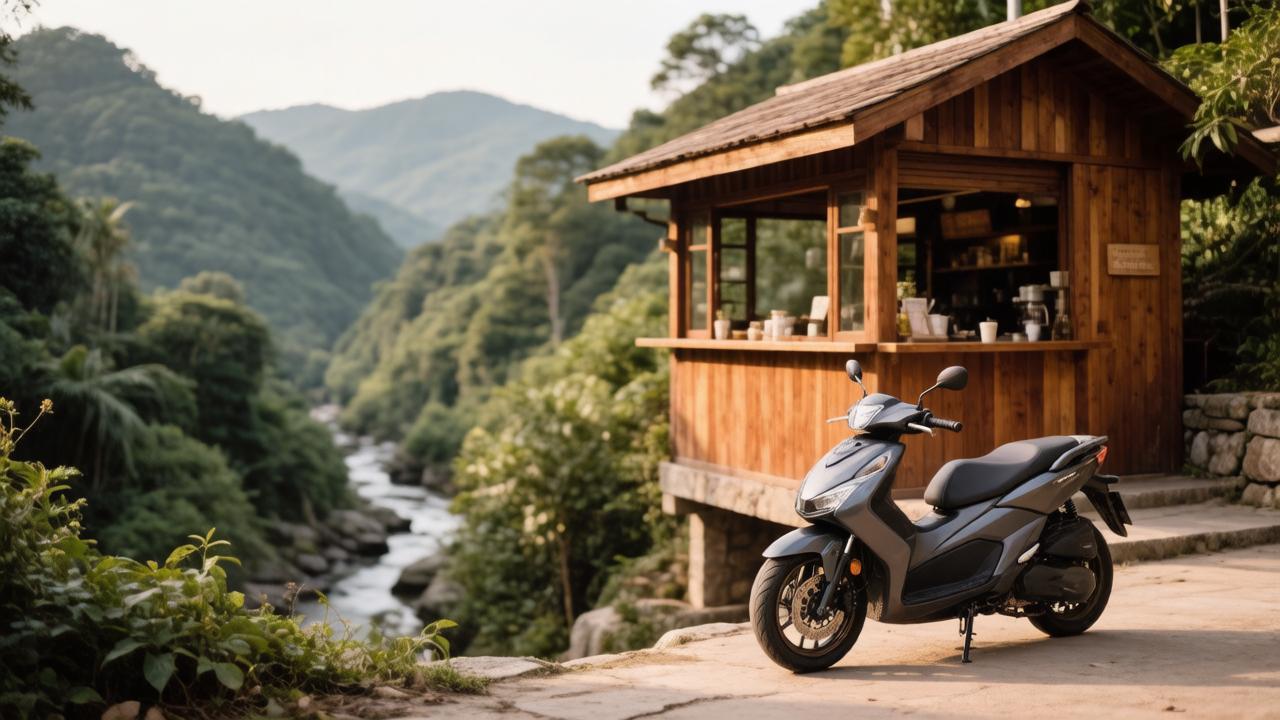
Tactical parameters for handling critical concrete gradients, narrow valley crossings, and altitude thermal shifts.
Tucked deep within a narrow mountain valley directly east of the provincial center lies one of the most culturally intact and geographically challenging destinations in the region. The eco-village of Mae Kampong, surrounded by ancient tea forests and misty coffee plantations, sits at an elevation that completely changes your driving requirements. Securing a reliable scooter rental provides the perfect agility needed to escape the heavy congestion of the valley floor, but reaching this isolated mountain community demands absolute focus. Navigating narrow concrete tracks, managing extreme vertical inclines, and understanding high-altitude mountain hazards is essential for ensuring a smooth, safe journey to the roof of the rainforest canopy.
The final ten kilometers of the approach shift rapidly from standard multi-lane asphalt into single-lane concrete strips that follow the natural contours of the steep mountain streams. This specific infrastructure requires a complete change in riding style compared to broad highway routes like the Samoeng Loop. The operator must handle continuous vertical grades that regularly exceed twenty percent, manage limited forward sightlines through dense foliage, and maintain constant awareness of oncoming local transport vans sharing the tight space. Learning to balance your throttle hand, managing engine heat buildup, and respecting local parking systems keeps your machine secure and your mountain journey flawless.
The Physics of Driving Extreme Vertical Concrete Grades
The concrete roads inside the upper eco-valley present unique traction conditions that differ significantly from standard hot asphalt surfaces. Local builders deliberately score the concrete lanes with deep horizontal grooves to help vehicle tires grip the surface during heavy monsoon rains. However, when these steep slopes are dry, this rough surface can create a vibrating ride that quickly tires out small-displacement automatic suspension systems.
When climbing these extreme inclines, momentum is your absolute primary defense against an engine stall. Lean your upper body forward over the front handlebars to shift mass onto the front wheel, keeping the steering column stable and preventing the front tire from lifting off the ground. Maintain a steady, confident throttle opening—avoid twisting the grip open and closed repeatedly, as this sudden action can cause the automatic CVT transmission belt to slip, causing rapid power loss and excessive heat buildup inside the drive casing.
Handling Steep Hairpins and Oncoming Transport Vans
The single-lane concrete tracks heading into the upper valley contain a succession of extremely tight, blind switchbacks where the road curves sharply around massive old-growth tree roots and granite rock walls. Because visibility through these corners is severely limited by thick jungle growth, local transport drivers always sound a heavy horn blast before entering the turn. Keep your speed low enough to swing the machine cleanly to the absolute left edge of the track if a vehicle appears around the corner.
If you are forced to bring your vehicle to a complete stop on a steep incline due to oncoming traffic, do not panic. Hold both brake levers down completely to lock both wheels firmly in place. To pull away safely from a dead stop on a hill, apply throttle steadily while slowly releasing the rear brake lever first, letting the engine build up sufficient torque to move the vehicle forward before releasing the front brake lever entirely. This controlled process eliminates any dangerous backward rolling and keeps the chassis completely stable.
During the cooler winter months, the heavy influx of local visitors trying to reach the mountain coffee shops creates severe traffic gridlock along these narrow tracks. Avoid traveling during weekend peak hours, as local delivery trucks often get stuck on the steepest climbs, forcing all behind them to complete difficult mid-hill balancing maneuvers. Setting off before eight o’clock in the morning ensures an empty road, cool mountain air, and a beautifully peaceful ride up to the high ridges.
Community Parking Rules and Eco-Valley Etiquette
The main street of the village is extremely narrow, with traditional wooden houses built directly over the rushing mountain stream. Leaving your machine parked carelessly along the roadside can block the entire community transit loop within minutes.
Managed Valley Lots
Utilize the designated multi-level public parking structures located at the lower entrance of the village. These secure spaces keep your vehicle off the narrow roads and protect it from structural damage caused by turning vans.
Gravity Defying Parking
When parking on any sloped lane inside the village area, position your vehicle’s rear tire facing directly downhill against the curb or a solid barrier. This prevents gravity from rolling the machine forward off its kickstand and causing a fall.
Exploring the High Ridge Coffee Plantations
Past the main village settlement, the concrete track continues upward toward the high mountain ridge separating the provinces. This upper sector features some of the highest coffee plantations in the region, where Arabica beans thrive under the shade of ancient jungle giants. The road here becomes even narrower, with a mix of broken concrete, dirt paths, and exposed bedrock tracks.
Riding through this upper canopy requires adjusting your suspension expectations. Small automatic wheels can slip easily on loose dirt surfaces or wet moss covering the damp concrete crossings. Keep your speed low, stay off the front brake lever entirely over slick spots, and let the engine’s natural momentum pull you through uneven sections smoothly. The reward for this technical riding is access to incredible ridge viewpoints that offer panoramic vistas across the entire valley basin.
Before heading back down to the plains, stop at a local viewpoint café to let your machine’s engine and transmission cool down fully from the intense climb. Use this time to inspect your brake system, check for tire pressure drops, and review your map options for the return leg. This simple maintenance break ensures your equipment stays in peak condition for the steep downhill run back to the valley floor.